Operational Chaos Steals Leadership Time
Here's How to Get It Back
If you spend your day answering the same questions, solving urgent problems, approving decisions, and fixing issues your team could handle, it’s likely not your fault.
You have a CHAOS problem.
Working harder, scheduling more meetings, or packing your calendar won’t solve this problem.
The real solution is to give your team the clarity they need: clear ownership, defined decision rights, transparent escalation paths, and a consistent standard for what good looks like. This way, your team can work without you being at the center of everything.
That’s when real leadership happens. You can focus on moving the business forward instead of getting stuck in daily rescue mode.
How to Stop Managing Operational Chaos
Trying to manage operational chaos doesn’t work because chaos cannot truly be managed. So, what should you do? Start by looking for it.
You can’t address chaos if you don’t notice it.
Most operational chaos comes from:
Unclear roles and responsibilities
Vague expectations
Inconsistent business processes
Too many decisions requiring leadership approval
Unclear translation from leadership intent to daily execution
No clear escalation path or decision guardrails
What happens as a result?
YOU become the answer to everything.
A team member has a question → they ask YOU. A customer issue comes up → they call YOU. A decision needs to be made → they wait for YOU.
Before long, you’re no longer leading the business.
You’re just trying to keep up with the chaos.
Here’s the trap: leaders often believe they need to get better at handling chaos.
They don't.
Instead, they need to build an organization that prevents chaos from happening in the first place.
5 Ways to Stop Managing Operational Chaos
1. Clarify Roles and Responsibilities
Gallup research shows that only 45% of employees clearly know what is expected of them at work.1 When expectations are unclear, leaders spend more time clarifying, correcting, and redirecting work instead of leading.
Everyone should know what they own, what they can decide, and when they need to involve someone else. Who is responsible for the outcome? What decisions can they make independently? When do they need to involve someone else?
If ownership is shared but decision rights are unclear, execution slows down. For example, if everyone is responsible, no one is truly accountable.
Clear ownership is one of the foundations of reliable execution.
2. Set Clear Expectations
“Take care of it.”
“Get it done.”
“Keep me posted.”
These aren't clear expectations. They're open to interpretation.
Your team needs to understand:
What needs to happen
Who owns it
What GOOD looks like
When it needs to happen
What decisions they can make independently
People can't consistently deliver what isn’t clearly defined.
3. Improve Your Business Process Operations
If you keep solving the same problem, stop and fix the process instead!
Create the checklist.
Document the workflow.
Build the decision tree.
Create the template.
Whatever makes sense for your business.
If you notice recurring questions, workarounds, or repeated decisions, it means something in your operating system isn’t clear enough.
Good processes don't create bureaucracy.
They reduce unnecessary interpretation.
They give your team a clear path forward without making YOU the go-to person for routine issues.
4. Create a Clear Escalation Path
Not every problem needs to reach YOU.
Your team should know:
What can I decide independently? What needs input before I move forward? What crosses a risk guardrail and must be escalated?
A simple framework is:
Decide → Align → Escalate
The goal isn't to eliminate problems.
It’s to make sure decisions move at the right level, with the right input, before work stalls.
That keeps routine decisions from becoming leadership bottlenecks and makes escalation a structural support rather than a last-minute rescue.
5. Stop Being the Bottleneck
This is where leadership can feel uncomfortable, but the pattern becomes clear.
If every decision needs your approval, every problem needs your input, and everyone waits for your direction, you’ve become the bottleneck.
The goal isn't to make yourself unnecessary.
It’s to stop making your involvement the default requirement for execution.
The problem isn't just how much leaders work. It's what their time is spent on. McKinsey found that more than half of managers and executives spend over 30% of their working time making decisions, and 61% say most of that time is used ineffectively.2
Reactive leadership deals with the same problems over and over. Reliable systems prevent these issues from needing your attention each time.
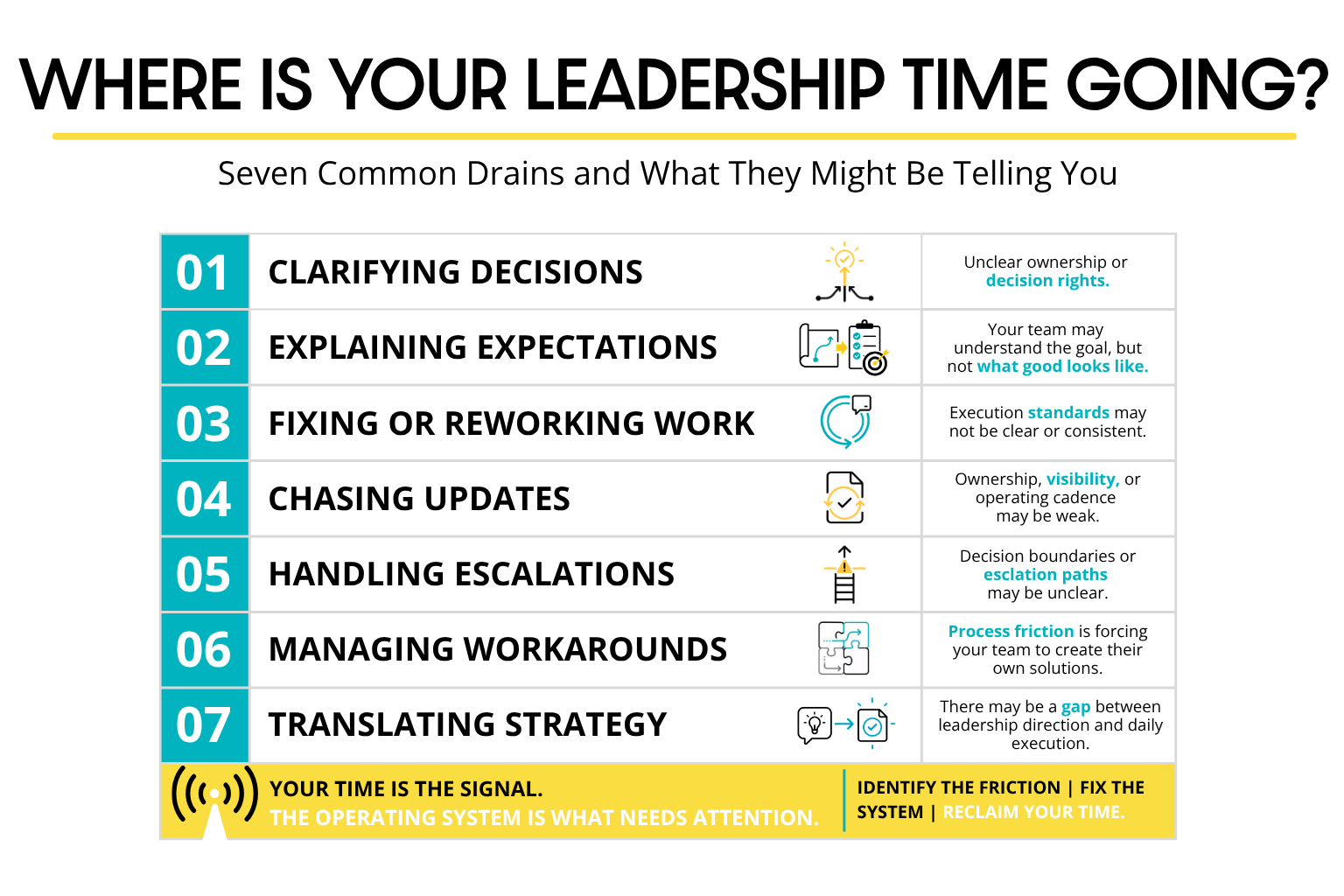
List of seven common drains on leadership time
What Leadership Looks Like When the System Works
The goal of leadership isn't to personally hold every detail of the business.
It’s to build an operating system where the right work can move without your involvement in every detail.
That means spending less time:
Answering the same questions
Fixing recurring problems
Approving routine decisions
Managing day-to-day chaos
And more time:
Thinking strategically
Reinforcing clear standards
Improving the operating system
Making important decisions
Building what's next
That’s how you get your leadership time back.
If your business can't operate without you in the middle of everything, the answer isn't to work harder.
It's to create more clarity.
Clear expectations. Clear ownership. Clear decision rights. Clear escalation paths.
Clear standards for what GOOD looks like.
Because when your business processes and operations work well, your team has clarity, and you’re not stuck in the details. Then you have the time and space to do what leaders are meant to do. If you spend too much time managing daily tasks instead of leading the business, it might be time to fix the system instead of just working harder.
Find Out Where Your Leadership Time Is Going
For five days, track the moments when you are pulled into work because something is unclear, stalled, misaligned, or dependent on you. You might be surprised by what you discover.
Download the Leadership Time Recovery Kit and identify where execution friction is absorbing your time and what you can fix to get that time back.
Find the friction points, then fix what causes them.
Sources: